
Expanding the frontiers of physics
Fermilab researchers use advanced quantum sensors to explore fundamental questions in physics, from detecting dark matter to developing new quantum technologies. Across multiple projects, they apply tools like superconducting qubits, atom interferometers and photon-counting detectors to push beyond the Standard Model and enable next-generation discoveries.
Axion dark matter detection
Researchers are looking far and wide for axions, theorized particles of dark matter, by using qubits as sensors. They aspire to coax them out of hiding by using a strong superconducting magnet to convert them into particles of light inside a microwave quantum resonator. Equipped with ultrasensitive, low-noise quantum electronics, a dark matter detector can be tuned to different frequencies corresponding to signals of axions of different masses so they can seek them in various mass ranges. Fermilab scientists have pioneered the use of superconducting qubits for single microwave photon counting, which has revolutionized the field of dark matter searches.
Through the Department of Energy Office of Science Quantum Information Science Enabled Discovery — or QuantISED — program, Fermilab scientists are working with university partners to develop next-generation quantum sensors and integrate them into high-energy physics experiments to explore new, beyond-Standard-Model dark sector physics.
MAGIS-100
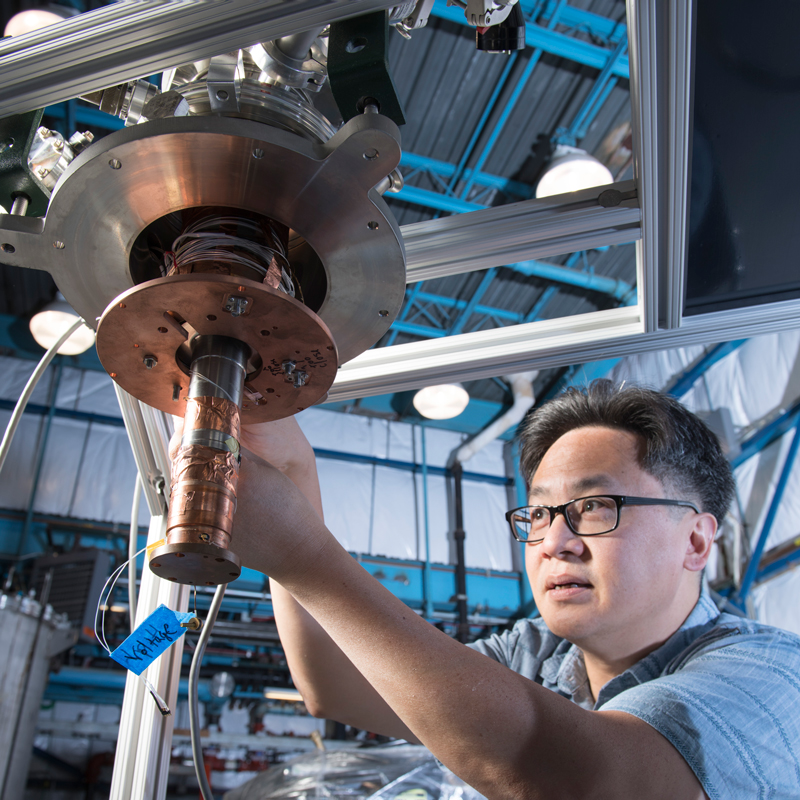
Scientists at the Fermilab-hosted 100-meter Matter-wave Atomic Gradiometer Interferometric Sensor are hunting for dark matter.
The MAGIS-100 project, currently underway and to be commissioned in 2027, combines Fermilab’s unique physical infrastructure with its expertise in vacuum and magnetic fields. Scientists will use quantum sensors and the world’s longest baseline atom interferometer — an instrument that measures differences in atomic wavelengths — to demonstrate quantum superposition of atoms over few meters for several seconds and to search for elusive ultralight particles of dark matter. Eventually, they will use these highly sensitive devices to investigate the nature of dark matter.
The pioneering technology used in MAGIS-100 could lead to experiments with even greater sensitivities.
Skipper CCDs for dark matter
One way to hunt for dark matter is to catch it in the act of bumping into a particle of matter, such as an electron. A sensitive enough detector could pick up on the transfer of energy between the two. Scientists at Fermilab have been using high-sensitivity devices called skipper CCDs to catch those energy-transfer signals, which manifest as single photons. The skipper charge-coupled device uses the quantum nature of light particles to capture images with extraordinary resolution. Skipper CCDs use highly sensitive quantum sensors to image objects one photon at a time — perhaps lighting the way to particles of dark matter.


Underground QUIET laboratory
Superconducting qubits are negatively impacted by environmental factors like radiation. Understanding those effects is key to designing more robust qubits or harnessing them as particle sensors. One hundred meters underground, the QUIET laboratory operates alongside its surface counterpart, LOUD. The paired facilities enable controlled experiments comparing environments with significantly reduced cosmic ray interference to those at the Earth’s surface. Each facility houses a state-of-the-art dilution refrigerator that enables 10mK operation of superconducting qubits equipped with the Quantum Instrumentation Control Kit, or QICK.