
Novel electronics for quantum technology
One of the main challenges in quantum science is designing an architecture that solves problems of massive interconnection, massive data processing and heat load. In addition, part of the electronics system must be able to operate in cryogenic environments.
Designing cryogenic electronics — processors and sensors that can work at temperatures near absolute zero — is a fundamental challenge. For electronics to be compatible with the millions of qubits required beyond the current intermediate-scale quantum computers, they must be able to operate at ultracold temperatures. The development of cryogenic electronics on a large scale would represent a huge leap forward in quantum computing technologies. Fermilab’s electronics engineers are at the forefront of this research.

Control and readout for quantum systems
Performing logic operations with small error probabilities in quantum computing may require many physical qubits. The electronics that control these qubits must be able to reset them, detect errors and correct them quickly. Fermilab experts are designing highly integrated control and readout electronics to be compatible with these large numbers of qubits.
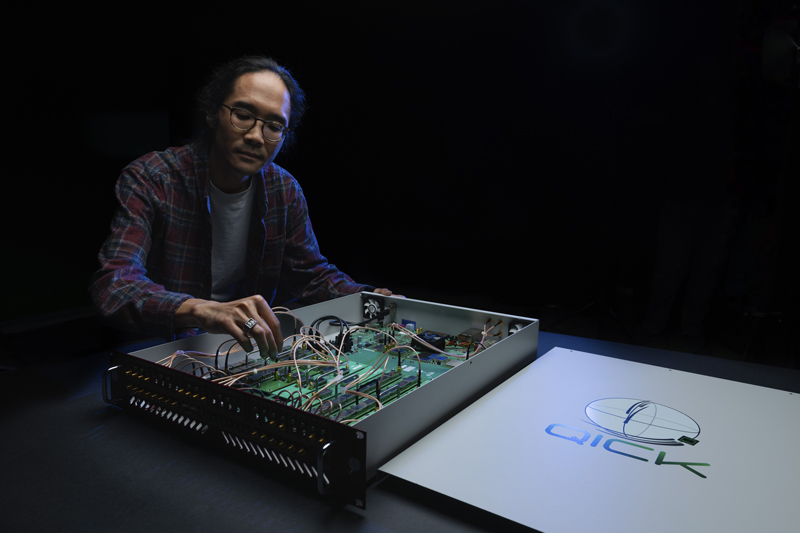
Fermilab led a team to develop the Quantum Instrumentation Control Kit — or QICK — an open-source quantum control and readout system comprised of a radio-frequency circuit board, control and readout electronics, and open-source software. This compact technology replaces the need for traditional hardware, reducing cost and saving space. Today, the QICK developers continue to engage with the broader community to extend its use for applications in quantum information science and beyond. QICK was developed with funding from the Quantum Science Center.